

Baptist vs. Methodist
What's the real difference?

A friend recently asked me the conflicts he was reading about and the theological difference between United Methodist Church (UMC) and Southern Baptist Convention (SBC). I’m no longer affiliated with either group, but since I was raised in the UMC and planted two SBC churches, I thought I’d put together a simple summary comparing the two
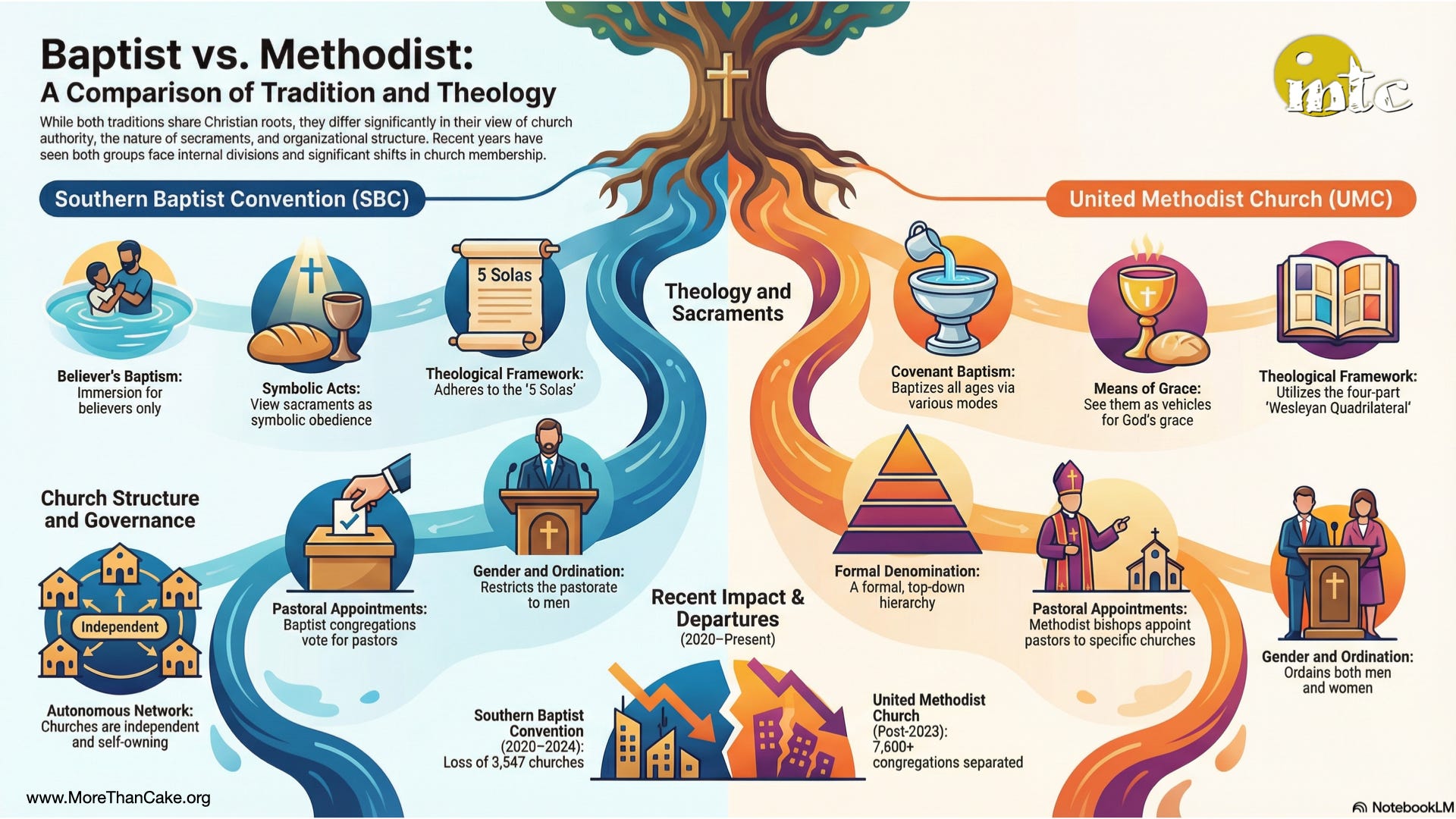
1. Historical
SBC
a. Broader Tradition
The Baptist tradition predates the Southern Baptist Convention and traces back to the early 1600s in England, where Separatists established congregations that rejected infant baptism in favor of believer’s baptism. Early Baptists emphasized local church autonomy, religious liberty, and evangelistic zeal.
b. Founding
The SBC was founded in 1845 in Augusta, Georgia, when Southern Baptist churches split from Northern Baptists over whether slaveholders could serve as missionaries and hold leadership positions in the church, effectively endorsing the practice of slavery.
c. Theological Divisions
In recent years, the SBC has been marked by internal conflict over issues of social justice such as Black Lives Matter/DEI and ordaining women for pastoral ministry (e.g., in violation of SBC policy, Saddleback Church and NewSpring Church ordained women pastors, sowed chaos, and then departed in 2023–2024). Tensions escalated after the ousting of ERLC leaders and other top figures accused of mishandling cases of sexual abuse. The conflict between progressives and conservatives contributed to a decline in the SBC’s total number of churches, dropping from 50,423 in 2020 to 46,876 in 2024. This represents a loss of 3,547 churches over the four-year period.
UMC
a. Broader Tradition
The Methodist tradition originated as a revival movement within the Church of England, beginning in the 1700s with John and Charles Wesley and the Holy Club at Oxford University. The term ‘Methodist’ was originally used by critics to mock their disciplined approach to religious practice, which included regular Bible study, prayer, and fasting. The early Methodists left a legacy of holy living (Christian perfection), vibrant ministry to the poor, sick, and orphaned, and the pursuit of social reform.
b. Founding
Various denominations carried on the Wesleyan tradition, but the United Methodist Church (UMC) was not formed until 1968 when the Methodist Church and the Evangelical United Brethren Church merged at the Uniting Conference in Dallas, Texas.
c. Theological Division
Like the SBC, the UMC has faced division over cultural issue. By the end of 2023, the United Methodist Church split over the choice by many leaders to queer their theology, embrace same-sex marriage, and ordain gay clergy. Tensions that had simmered since the 1970s came to a head when theologically faithful churches in the US and Africa, left the UMC. Since 2023, over 7,600 congregations have separated from the UMC with many joining the Global Methodist Church which now oversees more than 4,600 congregations worldwide.
2. The Sacraments
a. Meaning
SBC
Baptists see both Communion and Water Baptism as symbolic acts of obedience to the teaching of Jesus in the New Testament. Both of these “sacraments” (a word Baptists avoid) are treated as outward signs of an inward reality.
UMC
Methodists believe that both Communion and Water Baptism are a means through which the Grace of God is given to the believer. Neither sacrament can save the individual, but both are a way to experience the spiritual mystery of God.
b. Communion
SBC
Baptists practice a “closed” communion where only the believer is invited to participate in the bread and cup of Christ.
UMC
Methodists practice “open” communion wherein everyone; believer and non-believer alike, are invited to partake of the bread and cup of Christ.
c. Water Baptism
SBC
Baptists only baptize adults and children who are considered “old enough” and have professed faith in Christ, but not all Baptist congregations agree on a specific age. Baptism is by total immersion in water, symbolizing death, burial, and resurrection with Christ. Individual pastors may sprinkle in the case of medical disability or hospitalization, but this is not in alignment with accepted Baptist doctrine.
UMC
Methodists baptize infants, children, and adults as a sign of God’s covenant grace. Baptism may be administered by sprinkling, pouring, or total immersion in water, with no single mode considered theologically superior. The UMC emphasis God’s action in saving the baptized person over the mode.
3. Theological Authority
SBC
Born out of the Reformation, some SBC churches hold Calvinist doctrine, while others lean toward Arminianism. Southern Baptists use the “5 Solas” as theological guides.
Sola Scriptura (“by Scripture alone”)
Sola Fide (“by faith alone”)
Sola Gratia (“by grace alone”)
Solus Christus (“Christ alone” or “through Christ alone”)
Soli Deo gloria (“glory to God alone”)
UMC
The Methodist tradition follows in the Arminian tradition. While Methodists affirm salvation by grace through faith in Christ, they place greater emphasis on sanctification, Christian perfection, and practical holiness, which goes beyond the Reformation Solas framework. The UMC relies on the “The Wesleyan Quadrilateral,” a theological methodology developed by John Wesley. This method uses four sources for understanding and applying God’s truth.
Scripture (the primary authority)
Tradition (the historic church)
Reason (critical thinking and logic)
Experience (personal and communal)
4. Denominational Structures
SBC
The SBC is not a denomination, but a network of independent churches who choose to affiliate with the “Convention” based on shared values and theology. Each church, therefore, has its own policies, procedures, and is in full control of its own properties. In practice, the SBC operates like a denomination with an elected centralized leadership which uses the money given by local churches to fund global missions, disaster relief, church planting, and public policy projects like the Ethics and Religious Liberties Commission (ERLC).
UMC
The UMC is a formal denomination and has authority over each local church. The denomination owns the church property and buildings and can allocate its resources through the discretion of its denominational leaders. The Book of Discipline governs the actions of all Pastors, Bishops, Superintendents and church life.
5. Church Structure
a. Pastors
SBC
While the tradition of Elder plurality is practiced among some Baptist churches, the vast majority follow the Western tradition of leadership by a solo senior pastor. Baptists use the term pastor and elder as synonyms. The SBC officially restricts the office of pastor/elder to men.
Each Baptist church is autonomous, and congregations are responsible for selecting their own pastor(s), often through a search committee process followed by a congregational vote. Because pastors are not appointed by denominational leaders, they may move between churches when called, and congregations may also dismiss them. The SBC has no universal educational or ordination requirements for pastors.
UMC
Methodists follow an Episcopal model where pastors (elders) are ordained at a denominational level through the authority of the annual conference under a bishop. The UMC ordain both women and men equally to the office of pastor. All ordained pastors are appointed to a congregation through the bishop, working with the district superintendent and cabinet, who have authority to reassign pastors as needed. The itinerant system is used to keep the focus on Christ as head of the Church rather than on any single human leader. In smaller communities, some Methodist pastors are appointed to serve more than one congregation at the same time.
b. Deacons
SBC
The role of a deacon in Baptist tradition varies widely from church to church. Deacons may be men or women, though some congregations restrict the office to men. Selected from within the membership, deacons are called to a ministry of service rather than governance. Their responsibilities often include caring for the congregation, assisting with the ordinances of baptism and the Lord’s Supper, supporting outreach and benevolence ministries, and helping meet practical needs of the church.
UMC
In the UMC tradition, deacons—both men and women—are ordained for a ministry of service and Word. They serve in a variety of roles, including outreach, congregational care, leading worship, Christian education, and youth ministries. While they complete formal theological education, their requirements differ from those of elders (pastors), and they are appointed by the bishop to serve in connection with the church and annual conference.
Did I miss something?
I know my Substack is read by folks from both traditions, so if you have some corrections or additions, please leave a comment and help improve the quality of this post. Please also feel free to post links to other good articles or books that could be used for anyone wanting deeper study on anything in the post.